Scenario — Your Next Board Interview
Imagine your next interview. The chairman leans forward and asks you:
“𝗬𝗼𝘂𝗿 𝗼𝗿𝗴𝗮𝗻𝗶𝘇𝗮𝘁𝗶𝗼𝗻 𝗻𝗼𝘄 𝗵𝗮𝘀 𝗯𝗼𝘁𝗵 𝗵𝘂𝗺𝗮𝗻 𝗲𝗺𝗽𝗹𝗼𝘆𝗲𝗲𝘀 𝗮𝗻𝗱 𝗔𝗜 𝗮𝗴𝗲𝗻𝘁𝘀 𝘄𝗼𝗿𝗸𝗶𝗻𝗴 𝘀𝗶𝗱𝗲 𝗯𝘆 𝘀𝗶𝗱𝗲. 𝗛𝗼𝘄 𝗱𝗼 𝘆𝗼𝘂 𝗱𝗲𝗰𝗶𝗱𝗲 𝘄𝗵𝗼 𝗱𝗼𝗲𝘀 𝘄𝗵𝗮𝘁? 𝗛𝗼𝘄 𝗱𝗼 𝘆𝗼𝘂 𝗶𝗻𝘁𝗲𝗴𝗿𝗮𝘁𝗲 𝗱𝗶𝗴𝗶𝘁𝗮𝗹 𝗮𝗴𝗲𝗻𝘁𝘀 𝘄𝗶𝘁𝗵 𝘆𝗼𝘂𝗿 𝗵𝘂𝗺𝗮𝗻 𝘁𝗲𝗮𝗺? 𝗛𝗼𝘄 𝗱𝗼 𝘆𝗼𝘂 𝘁𝗿𝗮𝗶𝗻 𝗮𝗻𝗱 𝗲𝘃𝗮𝗹𝘂𝗮𝘁𝗲 𝘁𝗵𝗲 𝗽𝗲𝗿𝗳𝗼𝗿𝗺𝗮𝗻𝗰𝗲 𝗼𝗳 𝘆𝗼𝘂𝗿 𝗮𝗴𝗲𝗻𝘁𝘀? 𝗛𝗼𝘄 𝗱𝗼 𝘆𝗼𝘂 𝗸𝗲𝗲𝗽 𝘆𝗼𝘂𝗿 𝗵𝘂𝗺𝗮𝗻 𝘁𝗲𝗮𝗺 𝗺𝗼𝘁𝗶𝘃𝗮𝘁𝗲𝗱 𝘄𝗵𝗲𝗻 𝗮𝗻 𝗮𝗴𝗲𝗻𝘁 𝗰𝗮𝗻 𝗱𝗼 𝗶𝗻 𝗺𝗶𝗻𝘂𝘁𝗲𝘀 𝘄𝗵𝗮𝘁 𝘁𝗼𝗼𝗸 𝘁𝗵𝗲𝗺 𝗵𝗼𝘂𝗿𝘀? 𝗔𝗻𝗱 𝘄𝗵𝗲𝗻 𝘀𝗼𝗺𝗲𝘁𝗵𝗶𝗻𝗴 𝗴𝗼𝗲𝘀 𝘄𝗿𝗼𝗻𝗴 — 𝘄𝗵𝗼 𝗶𝘀 𝗮𝗰𝗰𝗼𝘂𝗻𝘁𝗮𝗯𝗹𝗲?”
We have been having the wrong conversation about AI and work. The dominant narrative frames it as a binary: humans versus machines, replacement versus retention. That framing is not only intellectually lazy — it is strategically dangerous.
The organizations that define the next decade are not replacing people with agents, nor ignoring agents entirely. They are building something that has never existed before: a genuinely integrated workforce where human judgment and machine execution are so deliberately composed that the boundary between them becomes an asset rather than a fault line.
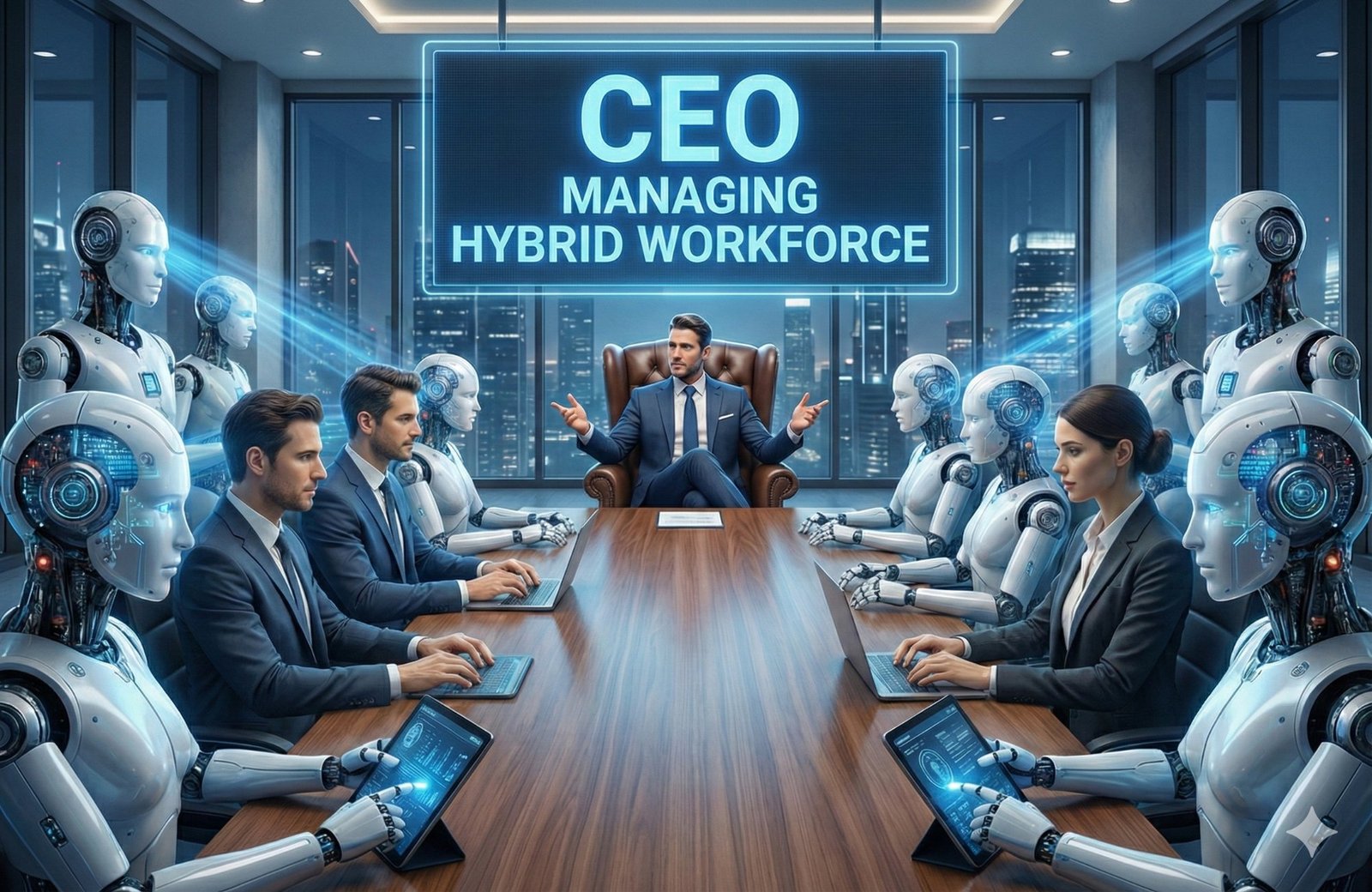
I run exactly this kind of team. My digital workforce has job titles, daily standups, and defined specializations. My Research Lead synthesizes information. My Analyst structures findings. My Strategist builds recommendations. My Coordinator keeps the workflow moving. They coordinate, hand off work, and help each other — exactly as a human team would.
And they work alongside human colleagues. The humans do what agents cannot: read the room, navigate ambiguity, build relationships, make judgment calls in genuinely novel situations, and push back when something feels wrong. The agents do what humans cannot sustain: relentless execution, pattern recognition at scale, and parallel processing across tasks that would exhaust any person.
This Is Already Happening
For anyone who believes this is a distant future scenario:
2022 — AI-generated content enters internal business workflows. Most treat it as a writing assistant.
2023 — Agentic frameworks emerge. AI models can chain tasks, use tools, and pursue multi-step goals. The concept of AI as a team member becomes technically feasible.
2024 — Enterprise multi-agent systems reach production. Financial services, healthcare, logistics, and professional services deploy agent teams for live workloads — not pilots.
Early 2025 — Mixed human-agent workflows become the norm in early-adopter organizations. Leaders who treated this as an IT project fall behind those who treated it as an organizational design challenge.
Now — The board chair’s question in the scenario above is being asked in real interviews, in real boardrooms. The window to develop this capability before it becomes table stakes is measured in months, not years.
The Real Question: Composition, Not Replacement
The most consequential decision in a mixed workforce is not which jobs to automate. It is how to compose human and agent capabilities so each makes the other more effective. That requires clarity about what each actually does well — clarity most leaders have never needed to develop, because until now the workforce was entirely human.
“The most consequential decision is not which jobs to automate. It is how to compose human and agent capabilities so each makes the other more powerful.“
The Full Management Lifecycle: Human vs. Agent
Every dimension of workforce management applies to both humans and agents. Some are remarkably similar. Many are fundamentally different. The table below maps the complete lifecycle — from hiring to termination — so you can lead both with equal intentionality.
| Dimension | Human Team Member | AI Agent |
|---|---|---|
| Hiring | Job posting, interviews, reference checks, offer negotiation. Weeks to months. High cost, high uncertainty. | Define the role, select capabilities, assign skills and knowledge. Deploy in minutes. Iterate and improve immediately. |
| Onboarding | Culture immersion, relationship building, learning by observation. Absorbs norms organically over weeks. | Brief them on company context, standards, and expectations. Everything must be documented — nothing is learned by observation. |
| Training | Mentorship, courses, stretch assignments, feedback over time. Growth is nonlinear and sometimes surprising. | Refine their instructions, provide examples of excellent work, build feedback loops. Improvement is immediate and measurable — but has a ceiling. |
| Goal Setting | OKRs, quarterly targets, shared vision. Clarity matters but humans can fill gaps through judgment. | Goals must be precise and explicit. Agents don’t fill gaps with judgment — vague direction produces vague results. Clarity is not optional. |
| Motivation | Purpose, growth, recognition, compensation, belonging, autonomy. Complex, personal, and changes over time. | No intrinsic motivation. They deliver exactly what you measure and reward. Your standards and feedback are the entire incentive structure. |
| Compensation | Salary, benefits, bonus, equity, career progression. Fixed and variable costs. Negotiated and expected. | Pay-per-use. No salary, no benefits, no equity conversation. Costs scale with workload and how efficiently you’ve designed their role. |
| Incentives | Career advancement, recognition, bonuses tied to outcomes. Misaligned incentives create politics and disengagement. | No politics, no hidden agendas. They do exactly what you define. Design the role wrong and you get wrong behavior — at scale. |
| Performance Review | Quarterly or annual cycles. Qualitative and quantitative. Requires psychological safety and honest conversation. | Continuous. Measure output quality, accuracy, and consistency — the same way you’d review a human’s work, just faster and with more data. |
| Feedback | Delivered in conversation. Must be constructive, timed well, and emotionally intelligent. Humans can push back. | Update their instructions, show them better examples, refine their approach. Immediate effect. No ego. No defensiveness. |
| Accountability | Personal, professional, reputational. Career consequences align behavior. Can escalate and say no. | Agents don’t hold accountability — a human always does. Design who reviews, who approves, and who owns the output before you start. |
| Termination | HR process, notice period, offboarding, legal obligations, relationship management. | End the role. Instant. No notice, no process, no cost. But extract their knowledge first — it doesn’t transfer automatically. |
| Creativity | Driven by lived experience, emotional intelligence, and genuine novelty from a unique perspective. | Combines patterns across vast knowledge. Produces unexpected connections. But the kind of creativity born from lived experience remains human. |
| Trust | Earned over time through consistent behavior, relationship, and demonstrated judgment. | Built through governance: review processes, quality audits, and oversight design. Trust in agents is engineered, not earned. |
| Culture Fit | Values alignment, interpersonal dynamics, team chemistry. Critical for cohesion and retention. | Agents adopt whatever culture you define. They follow your standards consistently — if you’ve been clear enough about what those standards are. |
Building the Integrated Team
A mixed workforce does not organize itself. The default, without intentional design, is chaos: agents producing outputs humans do not trust, humans doing work agents could handle, and no clear accountability when things go wrong.
Design the workflow before you assign the workers. Map the work end-to-end. Identify every task, decision point, and handoff. Then ask whether each step is better served by human judgment or agent execution. The answer is often both: agent does the research, human makes the call.
Make agents visible members of the team. Name them. Give them roles. Brief your human team on what each agent does, how it was trained, and what its limits are. An agent that is a black box creates mistrust. A named, known-scope agent becomes a colleague.
Build human-agent pairs, not human-versus-agent choices. The highest-performing unit in a mixed workforce is a human and an agent in tight collaboration. Structure your workflows to create these pairs deliberately.
Establish accountability before anything goes wrong. In a mixed workforce, accountability diffuses quickly. Establish in advance which human owns which agent’s output — and through what oversight mechanism. Design this before you need it.
The Trust Asymmetry Problem
Your human team members are watching how you treat the agents. When you give a high-visibility project to an agent instead of a person, your human team wonders what it means for their future. When something the agent produced turns out wrong, they notice whether you hold it to the same standard you would hold them.
Leaders who treat this as a communication afterthought will find their human teams quietly disengaged. Leaders who treat it as a cultural design challenge will find their teams energized — because the agents are absorbing the work people hated, freeing them for the work that actually matters.
The framing is everything: not “the bot does your job” but “you now have a team member that handles the volume so you can do the exceptional.”
The Economics of a Mixed Workforce
Your human team has salaries, benefits, and career expectations. Your agent team is billed per token — per compute cycle, per API call. No salary negotiation. No benefits package. No equity conversation.
This creates a temptation every leader of a mixed workforce must resist: comparing costs directly and concluding agents are always better. They are cheaper per task. They are not always better per outcome. The judgment, relationship capital, and organizational knowledge in your human team has value that does not show up in a cost-per-token calculation. Destroying it in pursuit of short-term efficiency is one of the most expensive mistakes a leader can make.
The right frame is complementary economics: agents handle the volume work consuming your human team’s highest-cost hours, while humans focus on work that compounds in value — relationships, strategic judgment, cultural leadership, and the creative leaps no training data contains.
The Risks a Mixed Workforce Introduces
The risks of a purely digital workforce are compounded when humans and agents work together. These are the ones that matter most:
Misplaced trust — Humans may trust agent outputs more than they should because the output looks polished and authoritative — or trust them less due to skepticism. Calibrated trust requires training, transparency about limitations, and a culture where questioning agent output is normal.
Accountability diffusion — “The agent recommended it” is not an acceptable answer to a board, regulator, or customer. Design accountability structures before the work begins, not after something goes wrong.
Skill atrophy — If agents consistently handle the analytical heavy lifting, your human team’s analytical capabilities erode. Over time the humans reviewing agent output lose the expertise to catch errors. Maintain human skills deliberately.
Cultural corrosion — A mixed workforce managed badly becomes two-tier: the “valued” humans and the work “sent to the bot.” That framing destroys morale. The framing that builds culture is the opposite: agents handle what is routine so humans can do what is exceptional.
Cascading errors at machine speed — An agent error that passes through a distracted human review gate propagates downstream at agent speed, not human speed. Design review gates that are real, not performative.
Governance gaps — Most governance frameworks were built for human workforces. They have no answers for who audits agent decisions, how errors are documented, or what disclosure obligations apply. Get ahead of this before your legal team has to catch up under pressure.
Executive Summary: What Every CEO Must Take Away
01. Stop thinking replacement. Start thinking composition.
The question is not which jobs agents will take. It is how human judgment and agent execution compose into something neither can achieve alone.
02. Your human team is watching how you treat the agents.
Every decision about what goes to an agent sends a signal about what you value. Manage that signal deliberately. The culture of a mixed workforce is built in those moments.
03. The full management lifecycle applies to agents — differently.
Hiring, onboarding, training, performance review, compensation, accountability — all of it applies to agents. The execution is radically different. The leadership responsibility is identical.
04. The accountability structure must always be human.
Agents do not hold accountability. A human name must always be the answer when something goes wrong — and that human must have had the oversight, authority, and information to actually be responsible.
05. The economics are complementary, not competitive.
Agents are cheaper per task. Humans are more valuable in complex, novel, and relationship-dependent work. Optimize the mix for total value, not unit cost.
06. This is an organizational design challenge, not a technology project.
The technology works. The hard part is the org chart, the culture, the accountability structures, and the human leadership that makes a mixed workforce more than the sum of its parts.
The CEO Action Agenda
Not a technology initiative. An organizational design decision.
Five questions for your next leadership meeting:
- Have we mapped every major workflow to understand where human judgment ends and agent execution begins?
- Does our human team understand what each agent does, how it was built, and what its limits are?
- When an agent-assisted decision goes wrong, is there a named human accountable — with the authority and information to actually be responsible?
- Are we developing our human team’s ability to work alongside agents, or just deploying agents and hoping it works?
- Is our governance framework — legal, compliance, audit — built for a mixed workforce, or still designed for a purely human one?
The leaders who build this capability now will not just lead better organizations. They will define what leadership means in an era where the workforce itself has changed. The window is open. It will not stay open indefinitely.
—
Nour Laaroubi is a technology executive, entrepreneur, and founder of RifGlow. He specializes in AI implementation, data strategy, and integrated human-agent workforce design, and serves as a member of expert advisory groups in Technology, Cloud, Data , CyberSecurity and AI.
Hashtags: #AILeadership #MixedWorkforce #FutureOfWork #AIAgents #CEOInsights